
On this page
Hello everyone, and welcome to the combined August and September 2026 Filen status update.
It has taken us a little longer to put this update together. To keep it useful and current, we are also including the latest development progress as we finalize the post in mid-October.
There is quite a lot to share. The new web app is in internal testing, with improvements ranging from everyday file management to document editing and broader media support. The Rust sync engine has reached an important implementation milestone, and work on the mobile app, backend, infrastructure, and developer tools has continued alongside it.
So, let us get started.
The new web app and desktop client
In our last update, we explained that the new web app had reached a broadly feature-complete state, with review and internal testing still ahead. The first internal beta is now being tested by our team. Since then, development has continued with further refinements and additional features, and our early impressions are very promising.
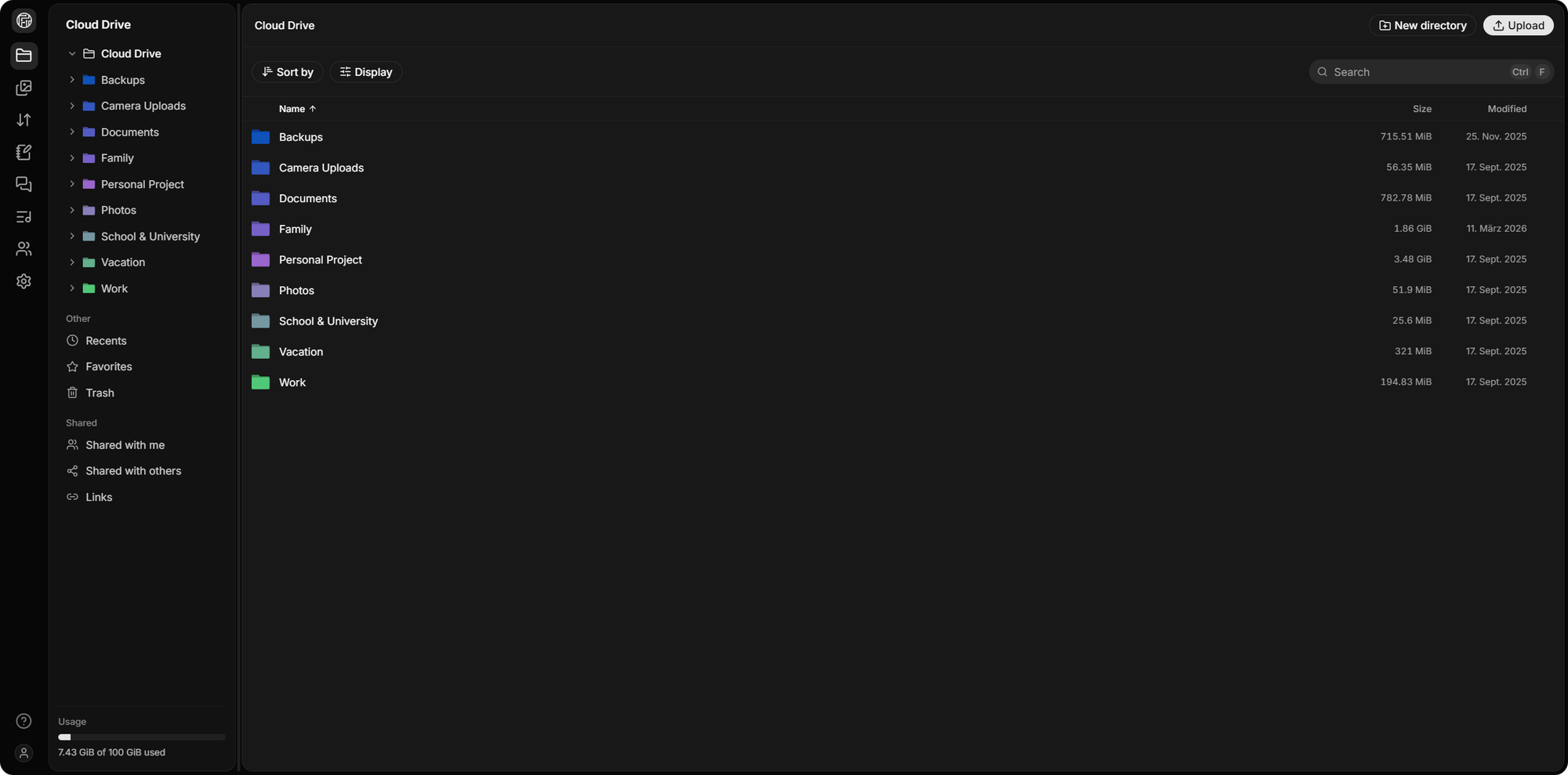
The new web app combines a redesigned interface with many quality-of-life improvements. Some of the changes already being tested include:
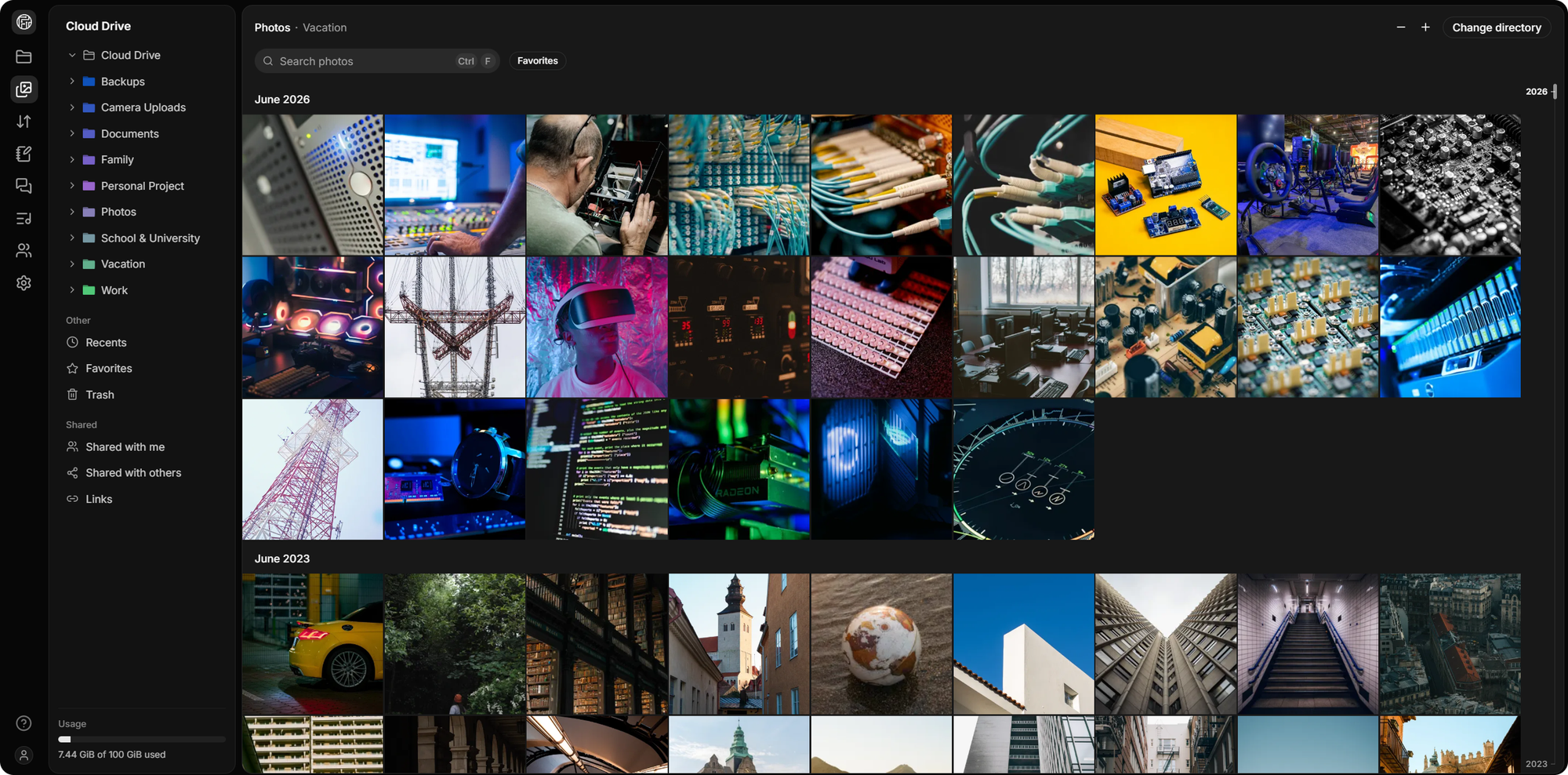
- A dedicated Photos section, bringing the gallery experience familiar from the mobile app to the web, with fast thumbnail generation and caching, search, and timeline scrolling (any folder can be designated as a photos folder and included in this section).
- A dedicated Playlists section, bringing another feature from the mobile app to the web.
- A redesigned navigation bar for easier access to your drive, settings, and the new sections.
- More responsive buttons, input fields, menus, and status displays.
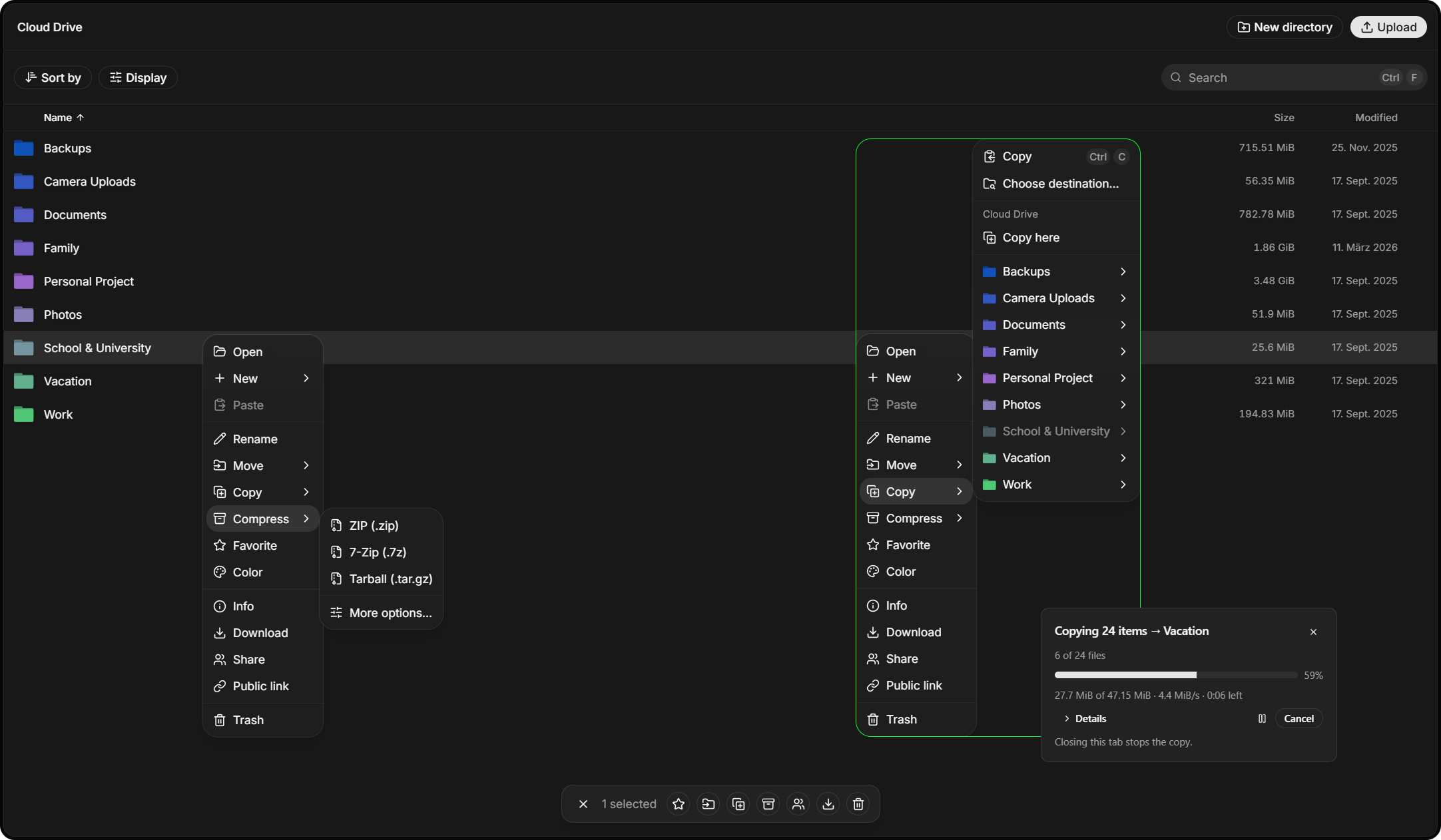
- Clearer sorting and display options, along with revised menus.
- Copying multiple files, folders, or a mixed selection to another location within your drive.
- ZIP creation, extraction, and archive listing through the drive interface, with processing and encryption handled locally on your device.
- RAW image previews and thumbnails, as well as thumbnails for SVG files.
- Improved PDF handling, particularly for password-protected documents.
- A resizable folder tree with draggable controls to adjust the layout.
- A Help section directly inside the drive.
Document editing is also becoming a much larger part of the new app. We have implemented viewing and editing for Word documents, Excel spreadsheets, and CSV files inside the web interface. These tools are still going through internal testing, but they should make it much more convenient to work with documents directly in your drive. We also plan to bring this work to the mobile app later.
One addition we are particularly excited about is a dedicated video library we are exploring for the new web app and desktop client. The aim is to offer a more convenient way to organize and enjoy films and series stored in Filen, with a personal media library similar to those offered by tools such as Jellyfin, integrated directly into your drive. You would select the folders to include, and the app would scan their subfolders, read the metadata, and organize your collection into a browsable interface for films and series. Rather than opening individual files from a folder list, you would be able to browse your collection, choose something to watch, and resume from your saved playback progress later. The library index would be built locally on your device. For now, the feature is being developed for files stored in your own drive; files shared with you by other users would not be included in the library.
This feature is still in its early stages, so we cannot yet promise that everything described here will make it into the final implementation or be ready for the initial release of the new clients. We are excited about its potential, but there is still development and testing ahead to establish what we can reliably deliver.
Beyond the planned video library, the new app also supports additional video and audio formats through client-side remuxing and transcoding. These address two different compatibility issues: remuxing puts existing audio and video streams into a different container without re-encoding them, while transcoding converts the encoding itself when needed. This means that an incompatible container does not necessarily require the video itself to be re-encoded. The processing happens locally on your device, enabling playback and previews of media files that previously could not be opened directly in the app.
Under the hood, the new web app also uses our new Rust SDK and includes improved request caching, which should make everyday navigation feel smoother.
The web app and upcoming desktop client continue to share much of their development work, with the new web interface forming the basis for the desktop experience. The features described here are at different stages of implementation and testing, so this is a preview of the work underway rather than a finalized release checklist.
We cannot give a firm release date yet, but based on the current progress, we still expect the new web app to be released before the end of 2026. Testing and stabilization will determine the exact timing.
A local AI assistant, running on your device
We know that “we’re adding AI” is not exactly everyone’s favorite announcement these days. So before anyone reaches for the unsubscribe button, let us explain:
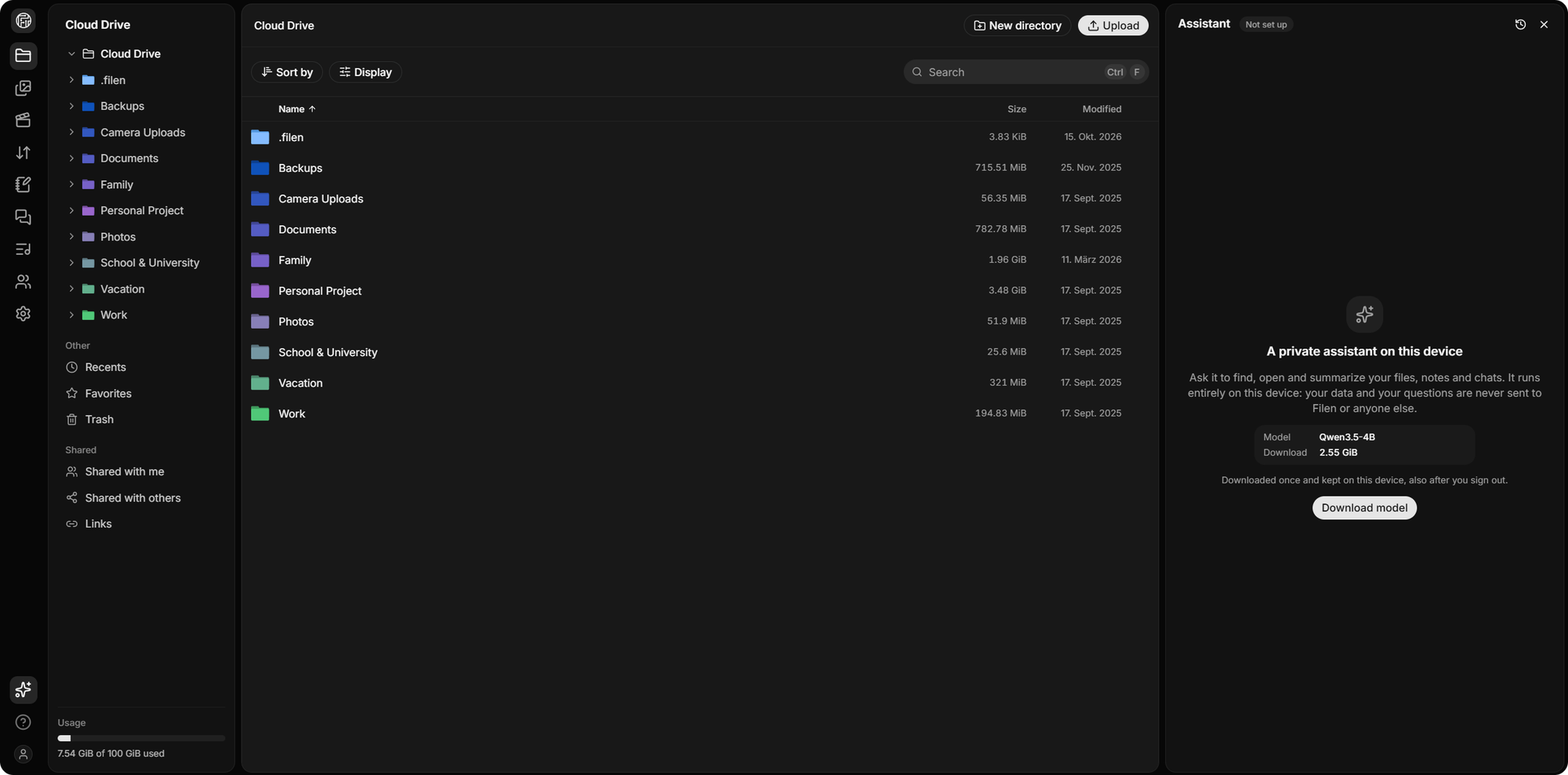
we are developing a local assistant for the new web app to help with everyday tasks such as finding files, navigating your drive, and summarizing notes.
The assistant runs directly in your browser. Your prompts and the content it processes stay on your device rather than being sent to an external AI provider for processing. Your files remain protected by client-side encryption. Normal drive operations still use Filen’s infrastructure, but the AI itself runs on your own hardware.
The assistant is entirely optional and only becomes active if you choose to set it up by downloading the model with a single click inside the web app. If you would rather skip AI altogether, simply leave it unconfigured. You can also hide the assistant interface with a single click, keeping your Filen experience focused on the features you want to use.
It can interact with the web interface, allowing you to see the actions it takes. Actions such as deleting files or emptying the trash are disabled in the current implementation. We are focusing on practical assistance within your drive, with realistic expectations about what a small local model can do. Its speed depends heavily on your device, and we still need to test more thoroughly how well it works on less powerful machines.
For those interested in the technical side, the current implementation uses a Qwen model with four billion parameters, running through a WebAssembly-compiled runtime. We are adding tools, fixing bugs, and evaluating its behavior against around 1,000 test prompts before making it available more broadly.
It also needs a name. Feel free to send us your best suggestions, preferably before we leave that decision to the assistant itself.
Progress on the Rust sync engine
The new Rust-based sync engine has made substantial progress.
In our June and July update, we covered improvements to the engine used by the current desktop client. The work described here concerns its Rust-based successor, which builds on our new SDK and caching foundation.
As of mid-October, the core sync functionality is implemented at the SDK level, and an implementation guide is available for the CLI integration. We are now working through the final performance improvements before the engine is ready for internal testing, followed by beta testing through the CLI first. Integration and further testing will follow as we bring it into the other clients.
Memory efficiency has been one of the main goals throughout development. Recent development tests have been encouraging, including a run involving around one million items while maintaining a low ongoing memory footprint.
We have been working toward a target of less than 100 MiB. During recent testing, memory usage remained below that level for much of the ongoing work, although larger synchronization runs could still produce temporary peaks above it. These observations concern the sync engine itself, rather than the total memory usage of the desktop application. Further optimization and broader testing will help us assess how consistently these results hold across different setups.
Alongside memory improvements, we also expect substantially lower CPU usage both while idle and at peak load during synchronization. This should reduce the engine’s impact on your system when it is waiting for changes as well as when it is actively processing files.
The engine also gives users more control over which files are synchronized. It supports nested filenignore rules and allows users to explicitly include items that would otherwise be excluded by the defaults. The rules follow familiar gitignore-style behavior, making them easier to understand and customize for more advanced workflows.
We are also adapting the engine to use the new backend bulk operations described below. This reduces the number of requests needed when processing many items. The overall goal remains the same: reliable synchronization that handles complex folders and large collections without putting unnecessary pressure on your system.
Mobile improvements and the new iOS file integration
Work on the mobile app continued after its release, including the file integration changes discussed in our last update.
Previously, changes made to Filen files through third-party iOS applications were not always uploaded back correctly. Addressing that workflow required a rewrite of our integration with Apple's Files app using the newer Replicated File Provider system.
The rewritten integration has now been included in a mobile update. Follow-up work has included fixes for File Provider crashes and further performance work. The Android Documents Provider also received maintenance, and we addressed mobile crashes during this period.
We have also reworked thumbnail generation and expanded image preview support, including support for many RAW camera formats. This work benefits the mobile app and is being carried into the upcoming web and desktop clients, allowing us to reuse the same implementation across products.
We will continue reviewing reports and refining the app. Exact device information and clear reproduction steps remain especially helpful when a problem only appears with particular devices or workflows.
Further backend performance improvements
Alongside development of the new clients, we have continued optimizing the backend that powers the applications available today. Recent work focused on upload handling, caching, and the coordination of concurrent operations, improving efficiency across several frequently used parts of the service.
Following these changes, our internal figures showed approximately 80 percent lower memory usage on the affected backend servers and around 50 percent lower CPU usage on the API and upload nodes. These figures describe resource usage in those systems, rather than an equivalent increase in individual transfer speeds. They are also separate from the database utilization improvements reported in our previous update.
We have also been adding bulk operations that allow clients to group actions such as creating, moving, or renaming multiple directories into a single request. This reduces request overhead when processing larger collections. Work is underway to integrate these operations into the new Rust sync engine.
These improvements support the current applications while development of the larger API v4 rebuild continues separately.
Infrastructure and operations
Work on our self-hosted infrastructure in Germany has continued alongside application development. During this period, we focused on storage-cluster maintenance, configuration improvements, and preparations for additional hosts, supporting the continued operation and expansion of the platform.
We are also refining our existing monitoring and internal operational tools. The focus is on bringing relevant information together more clearly and improving the context available when investigating alerts or planning maintenance. This is ongoing work to make day-to-day operations more efficient as the infrastructure grows.
Alongside this, we have expanded our hardware diagnostics capabilities to support maintenance and equipment assessment. Much of this work happens behind the scenes, but it remains an important part of maintaining the infrastructure our users rely on.
Rust CLI and integration work
The Rust CLI continued moving closer to feature parity with its predecessor.
Work during August and September included more detailed file and directory information, additional trash commands, restoring and permanently deleting trashed items, non-interactive search, exporting notes, listing recent files, and managing public links.
Integrating the new sync engine is one of the next steps for the CLI. As outlined above, final performance optimizations are underway, with internal testing to be followed by beta testing through the CLI first. The new CLI does not yet replace every existing workflow.
We are also developing an experimental MCP server and a JSON-RPC interface around the same underlying operations. The aim is to make those operations easier to use from compatible tools and automation, while sharing more of the implementation and testing with the CLI.
This integration work is separate from the local assistant in the web app, which uses its own tools to interact with the interface. Both remain in development, and we will share more when they are ready for broader use.
Security input and preparation for API v4
We previously explained that we wanted to involve external security expertise earlier in development.
During September, discussions became more concrete with a security researcher who has already provided useful input on our planned API v4 work. We are exploring how a structured collaboration could support architecture reviews and technical questions during development. A formal audit remains a separate step.
There has also been early research and prototype work on how large accounts could load and update metadata more efficiently in API v4. One goal is to avoid requiring clients to fetch an entire large metadata database when starting on a new device, while preserving the privacy properties we want from the next architecture.
Implementation details are still being evaluated. We will share more once the design is mature enough to explain clearly. For now, finishing the client migrations and integrating the new sync engine remain the immediate priorities.
Improving connectivity and working with DNS providers
As discussed in previous updates, abuse of the service can also affect accessibility for ordinary users. Domains used by Filen can end up on blocklists maintained by security-focused DNS providers or their threat-intelligence sources, causing connection problems on networks that rely on them.
Alongside measures such as the changes to free storage eligibility for new accounts created through anonymization networks, we have contacted a large number of DNS providers to address these problems directly. This has improved connectivity for many users and, in a number of cases, restored access to Filen entirely.
Separately, some users in Türkiye continue to experience connection problems on particular networks. Recent troubleshooting suggests that changing DNS alone does not resolve all of these cases. Some affected users have been able to connect through a VPN or Cloudflare WARP, but these are workarounds, and the underlying connectivity issues remain under investigation.
If you are having trouble connecting and the usual troubleshooting steps have not helped, please contact our support team. Your country, internet provider, DNS provider (if known), the affected app or service, and the exact error are useful starting points. Knowing whether the same problem occurs on another network can also help us narrow down the cause.
Whenever reports reveal recurring problems linked to our infrastructure, external providers, or other parts of the connection path, we investigate and work to address them. Your reports help us identify patterns that we may not be able to reproduce from our own networks.
Marketing and preparations for the end of the year
Our creator partnerships have continued alongside the development work. We are now preparing further collaborations for the Black Friday and Christmas period, including the briefing material and product information creators need.
The details of this year's Black Friday campaign are still being worked out. We will share the actual offers and timing separately once they are finalized.
Closing words
The work of August and September has continued into an increasingly busy October. The next web app is now in internal testing, the Rust sync engine has reached an important implementation milestone, and the mobile app and current backend have received further improvements.
There is still testing, integration, and refinement ahead, but we can now share much more of what these projects will bring to everyday use.
Thank you for your support, your patience, and your feedback. Clear reports and practical suggestions continue to help us understand what matters most to the people using Filen.
Until the next update,
-Team Filen